French Tourism pledged support for Sri Lanka Tourism


Minister of Tourism, Milinda Moragoda on his recent visit to France met with Monsieur Luc Chaphel, the Minister (Secretaire de l’etat) of Tourism and Consumer Affairs in France and discussed several areas for corporation.

A framework for a MOU to be signed at a future date was also discussed in detail. Mr. Chaphel pledged his support in the areas of hotel classification, training of staff in hotel management and destination marketing. Mr. Chaphel further requested information on projects undertaken to combat global warming.

Minister Moragoda was accompanied by the Sri Lankan Ambassador in France Ms. Chitrangani Wagiswera, Chairman Sri Lanka Tourist Board Mr. Renton de Alwis and Additional Director General Sri Lanka Tourist Board Mr.Dileep Mudadeniya.

France has recorded an average 35,000 tourists along with 300,000 roaming in 2004 and 2005. Subsequent to the travel advisory in October 2006 arrivals dropped sharply. Sri Lanka Tourism is optimistic that the change of the advisory and the recent visit to France by the Hon. Minister, will provide a kick start for winter arrivals 2007/2008. Arrivals from France mainly patronize hotels and attractions in the Cultural Triangle.

The Sri Lanka Tourist Board recently conducted an independent securing audit which resulted in the French tourism operation resuming the selling of Sri Lanka as a holiday destination. The results of the audit was presented on the 11th September at UNESCO and followed by several of promotional activities.

A separate event was organized to launch the World Tourism Day celebration by inviting leading women to the travel and tourism industry in France. 10 French students studying tourism were invited to submit the projects they have worked on the degree programmes and same was presented to the panel consist of key women professionals. This session was conducted by a welknown TV personality Alexandra Debanne.

A separate cultural show was also organized at UNESCO with more than 1000 spectators that comprised of mainly travel agents and tour operators while Sri Lanka also launched a special promotional campaign titled “Half a price for better half” to increase the numbers immediately.

Labels: , ,


The Fortress, Galle, Sri Lanka debuts world’s most expensive desert


Rocking the culinary scene with its innovative style

Located on the southern golden coast of Sri Lanka, this 49 roomed luxury resort has carved itself on the world map by creating the most expensive dessert in the world.

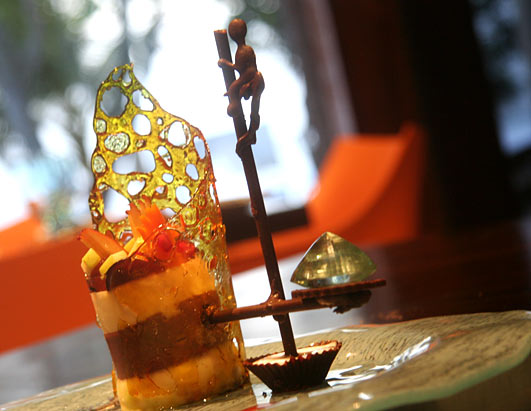
Priced at USD 14,500, ‘The Fortress Stilt Fisherman Indulgence’ is a combined effort by the resort’s culinary team to create a one of a kind dessert that is intrinsically linked with the destination, offering both long lasting memories and a keepsake of the experience. Available now on special request, the dessert’s inspiration comes from the resort’s logo of the ‘stilt fisherman’, a centuries old fishing practice that continues to this day and can still be seen along this spectacular coastline.

A combination of a gold leaf Italian kasata flavored with Baileys and served with a mango and pomegranate compote and a champagne sabayon enlighten, forms the mouthwatering base of this delicious desert, however, the finishing touch is the 80 carat aquamarine stone nestled on the handmade chocolate stilt fisherman. This one of a kind culinary delight has definitely got people around the world buzzing with awe.

Legend has it that an aquamarine has the power to calm, sooth and heal. Its blue colour is often reflective of the ocean and the life giving properties of water and has been used over the years by sailors and fishermen for protection and luck. It also has a soothing effect on relationships and is said to endow the owner with foresight, courage and happiness, the recipe for a long and happy marriage and the perfect gift for those looking to surprise their loved one.

This dessert is served at Wine³, The Fortress’ sensational glass wine cave which houses over 2,000 of the world’s finest vintages and is accompanied by handmade studio flared glass cutlery – the first glass cutlery of its kind in the world which has been exclusively designed for The Fortress by Glass Studio.
Website: http://www.thefortress.lk/home.html

source:http://www.dailymirror.lk

Labels: , , , ,


Germany, UK review travel advisories

Subsequent to the successful tourism promotions in France and The Netherlands, Sri Lanka Tourism had further good news in the German and the UK markets. The travel advisory in Germany was reviewed by the authorities.

The earlier 'advice against travelling to Sri Lanka if not essential' has been deleted from the text of the German travel advisory. Director of the Tourist Board Office in Germany Channa Jayasekera said "this would definitely be most encouraging to the tour operators and travel agents selling Sri Lanka, as the earlier advisory led to confusion and was negatively interpreted by the public.

After a stakeholders meeting organised by the Sri Lanka Tourist Board Office in the UK, where our concerns were shared through the Pacific Asia Travel Association's (PATA) UK Chapter, Association of National Tourist Office Representatives (ANTOR) and Association of British Travel Agents (ABTA) to the Foreign and Commonwealth Office (FCO), the FCO has further softened their travel advisory to Sri Lanka.

"The advisory has been reviewed and reissued with an amendment to the Summary and local travel section, where it now states 'we no longer advice against travel to the city of Anuradapura' Director UK and Ireland of the Tourist Board Jean-Marc Flambert said.

Labels: , , , ,


Hotel Flower Garden - The Paradise Garden in Unawatuna

UNAWATUNA beach, in the Galle district, is classified as one of the most beautiful and fascinating beaches in the world. Unawatuna is a paradise for beach lovers, both foreign and Sri Lankan.
The beach is surrounded by a number of star class hotels, and cabanas and is one of Sri Lanka’s most popular tourist destinations. Most of the hotels which were damaged by the tsunami, have now been completely refurbished, and Unawatuna has regained its glamor and splendor.

True to its name, Hotel Flower Garden, at Unawatuna, has been built on a marvellously landscaped one-acre garden which resembles a min-flower garden. It is located within walking distance to the world famous Unawatuna beach, in Galle district.

The hotel which began with nine cabanas in 2003, now offers 25 luxury cabanas with all modern facilities to the discerning traveller.

All cabanas are equipped with A/C, hot/cold water, mini-bar and room service. Hotel Flower Garden has a beautiful and large swimming pool and a well stocked bar.

The restaurant offers the very best in Western, Eastern and Sri Lankan cuisine, together with an ‘A-la-carte’ menu.

The restaurant specialises in French, Italian and German cuisine, the preparation of which is personally supervised by the young owner of the hotel, K. Sassi, who holds a Degree in Food and Beverage, having successfully completed a course in Hotel at Ricken, St. Gallen, Switzerland, for five years as its Food and Beverage Adviser from 1992 to 1996. The hotel offers tours to Koggala Lake, Turtle Farm, fishing in Weligama Bay Beach.

A visit to the ‘jungle beach’ is a unique feature offered by the hotel to tourists.

Labels: , , , , , , , ,


French to return to Sri Lanka

French tourists, hopefully in droves, are poised to return to Sri Lanka after the country was cleared for travel as a tourism destination.

A Sri Lanka Day organized by its Tourist Board office in Paris was held last week with Minister of Tourism Milinda Moragoda, Chairman of the Tourist Board Renton de Alwis and the Additional Director-General Dileep Mudadeniya attending in order to introduce new products and the measures taken to re-launch the destination and renew its identity.

The Tourist Board said in a statement that the Sri Lanka Day provided an opportunity for the Board to reveal vital information for the French market.

It said fully aware of its negative image in the French market , Sri Lanka Tourism opted for transparency and requested an independent private French security firm to conduct a security audit related to tourism activities. The evaluation, conducted over a period of 12 days by Sécurité Sans Frontières (SSF), covered various tourism sites, hotel infrastructures, airport and other forms of transport as well as general conditions of security (political, social, health and weather-related issues). The findings and methodology and the fact that it was performed independently (no complicity) of the audit were revealed to the public on September 11 at UNESCO. According to Frédéric Bauer, Président of SSF, “the in-depth study of the security conditions has permitted us to make specific and detailed technical recommendations. The terrorist risk is not that greater in Sri Lanka than other countries visited by the French …. In conclusion, the security situation for us is acceptable for tourism visits to Sri Lanka and I take responsibility for recommending the destination for French Tourists.”

The Board said this positive conclusion is a welcome change to the position adopted by the travel advisory of the French Foreign Ministry which contributed to a great extent the increasing negative perception of the destination due to the security problems related to the North and East of the country.

The active re-launch of the destination will be put in place through various activities with the tourism professionals. They included a “Half Price for your Better Half” from October to December 2007 and January 2008 package; Incentive for Travel Agents; Mega fam trips; Joint Promotions by the Sri Lanka Tourist Board and Tour Operators willing to participate on an equal basis in the costs; a Treasure Hunt that will take place from October 5-12 in Sri Lanka to discover exceptional tourist sites for travel agents.

Labels: , , , ,


Sri Lanka hopes for tourism recovery with easing of travel advisories

Sept 15, 2007 (LBO) – Sri Lanka is confident of achieving its target of attracting 600,000 tourists this year following the relaxation of travel advisories in key markets, tourist board officials say.

"We are confident that this year, looking at the progress we have, we'll be able to achieve 600,000 tourists for this year," S. Kalaiselvan, director general of Sri Lanka Tourist Board (SLTB) told LBO.

Some 44,500 tourists visited the island in August, considered one of the peak seasons, with a traditional Buddhist pageant in the central hill country town of Kandy in which a phalanx of elephants parade, being a major attraction.

Although the number was lower than last year's arrivals for the month, the SLTB is confident the winter season will be better than last year's as European countries have lifted and relaxed some of the travel warnings that were in force.

"The French travel advisory has been liberalized now and is more conducive for the French tourists to visit us. The Netherlands have also lifted their travel advisory," Kalaiselvan says.

"These are good signs to say that the situation in Sri Lanka is conducive for tourists to visit."

The country got over 313,000 tourist arrivals up to August but it was nearly 92,000 lower than the number of visitors compared to the same period last year.

The travel advisories were issued last year when the conflict between the between Tamil Tigers and the government forces intensified.

The Tigers attacked key points in the capital as well as other parts of Sri Lanka during the last quarter of 2006 which led to a sharp fall in tourist arrivals.

This resulted in many hotels being virtually empty during the off-season with average occupancy dropping to around 45-50 percent.

According to statistics, Sri Lanka was unable to achieve the 600,000 visitor target last year and had to settle for 559,000 tourist arrivals.

The country's 26-billion-dollar economy earned nearly 400 million dollars from tourism last year, the fourth largest foreign currency earner behind tea, clothing and remittances from abroad.
Source : LBO

Labels: , , ,


Clunes Villa: Haven in the valley


By Sanath Weerasuriya

Clunes is a popular name from Scotland. After Scottish planters, Sri Lanka inherited many Scottish names in the plantation sector. Like in Victoria, Australia after the European settlers in the nineteenth Centaury, Clunes came to stay in Sri Lanka not as a township but as a estate name in low country.

But our story about Clunes is a Sri Lankan holiday destination situated just one hour and fifteen minutes drive from Colombo.‘Clunes Villa’ is a Colonial estate bungalow turned to a modern holiday home specially catering for nature lovers. Situated in the middle of rich rubber plantation in Errachi Division in Talduwa Estate, Dehiowita, the Villa is nearly 87 years old.

‘It is just six kms away from Avissawella town on the main highway to Hatton and you can arrive at the Villa within two hours from the Bandaranaiake International Air Port’ said Thushara Sanjay Gunaratne, the Manager of the Villa.

Clunes Villa was originally built in 1920 for the exclusive use of the Scottish Planter John Dunlop. The bungalow maintains its past glory to fit with modern times although extensive repairs were carried out by Clunes Villa's present owner Gajaba Pitigala, the former Sri Lankan cricketer.

This colonial bungalow is exquisitely built in the centre of five acre tropical jungle with spacious halls, three large bed rooms and two roomed suite with all modern amenities.

‘After I took over this place in 2005, I have spent nearly 15 million on refurbishment to bring it to the present look’ said Gajaba Pitigala, the proprietor of this beautiful bungalow. The biggest change will be the newly constructed swimming pool. 'It will be ready for the use of holiday makers within a couple of months' Pitigala said.

All the rooms are fully air-conditioned, a private balcony with a spectacular view of the forest or lake, hot/cold water, laundry services, tarnish baths and on call doctor service, Neutral tones of brown beige and yellow comprise the brightly lit interior which is traditional yet modern which create the slick but simple picture.

The culinary experience at the Villa is one of the highlights of the holiday at Clunes. Clunes Villa allows dining in air conditioned comfort or in the more informal settings of the landscaped garden. It also has an adjacent bar and large area which is strictly for members and visitors of the villa for pre or post dinner drinks, cocktails and coffee.

‘Dining at the Villa is the most important thing. From simple village meal to five star dining experiences is on the menu at Clunes. Our experienced cook is capable of handling any kind of dish’ said Gajaba.

H. G. Karunaratne, popularly known as Karu, the main cook at the Clunes Villa has more than 40 years of culinary experience behind him.He was the chief cook at the Flight Kitchen of the former Grosvenor Caterers, the caterers for the former Air Ceylon and for all outbound flights from Katunayake.

‘At Clunes we treat all guests as Colonial Masters. From English Breakfast to Sri Lankan lunch and High Tea to candle lit dinner is possible at the Villa’ said Karu.

‘If you are a lover of Western, Eastern or Chinese food our kitchen caters for all your needs. Special BBQ nights can be arranged on request to make you feel comfortable and at home’ said Manager Thushara. Clune is also apopular place for foreign weddings.

‘We have already done about 15 weddings of European couples’ said Pitigala. The Villa is centrally located in close proximity to most of Sri Lanka's natural beauty and its world-renowned heritage. The Villa is an ideal base for excursions to Sinharaja Forest, Udawalawe Wildlife Sanctuary, Botanical Gardens, Pinnawela Elephant Orphanage, Horton Plains, Nuwara Eliya, Adam's Peak, Saman Devalaya, Temple of the Tooth Relic in Kandy, Beli Lena and many more places of interest.

The Villa is surrounded by rubber and tea estates and is in close proximity to popular waterfalls.‘Clunes Villa is a place for adventure lovers. You can experience white water rafting at Kithulgala just 30 minutes away from Clunes Villa. Experience a day out with your family at Water World in Hanwella, which is just 20km from the Villa' Mr Pitigala said.

The ruins of Seethawaka Kingdom, Burundi Kovil, Dahanwela Seethawaka Oya are some of the attractions at the close range just fifteen minutes away from the Bungalow. 'The Villa is just 60km north of the world famous Sinharaja Forest and tours can be arranged for all guests on requests to visit the forest which takes just under 2 hours journey' Gajaba explained about the arrangement on excursions.

Like wise Udawalawa Wild Life Sanctuary is just under 21/2 hours journey and Udawalawe, which lies within the Ratnapura and Moneragala Districts, acts as the catchments to the Udawalawe Reservoir and is located in the Dry Zone. This Park comprises grasslands and thorn scrubs and many valuable species of trees are found within it. Large herds of Elephants and Deer species such as Spotted Deer, Sambhur, Barking Deer and Langur, Wild Boar, Water Buffalo, Jackal are some of the prominent wild animals found in this Park.

Botanical Gardens in Peradeniya and Haggala too are just under two and half hours drive from Clunes. Nuwara Eliya, Horton Plains, Pinnawala Elephant Orphanage , Tea Garden and Water falls are around two to three hours drive from the Villa. Official web site of Clunes Villa : www.clunesvilla.com.

Labels: , , ,


The parent trip

Simon Hoggart embarks on a holiday in Sri Lanka with the kids — but this time they are the ones in charge


Where to go ... daughter Amy's advice includes a visit to the celebrated Dambulla cave temples. Photograph: Maurizio Gambarini/dpa/Corbis

When your kids are small, you inform them where the family holiday is going to be. If they don't like it, they know what they can do — which is, come along and enjoy themselves. Or else. But when they're older — ours are 21 and 18 — and you want them to choose your trip in preference to them spending a riotous week in Spain with their friends, you have to ask them politely where they would like to go. And it's you who must like it or lump it.

Which is why we went to Sri Lanka this year. Our daughter Amy, the 21-year-old, had spent part of her gap year working in an orphanage there, up country, near Kandy. She and the other volunteers had been adventurous, using every weekend to visit historic sites, temples, national parks, the tea-growing area and, of course, the beaches. They met some delightful people, ate terrific food, and had a thoroughly exciting time. It was these places that she wanted us to enjoy. Meanwhile, she planned to spend a few days back at the orphanage, getting to know the nuns again, caring for the children.

We could not have chosen a better time. The fear of terrorism (irrelevant to tourists, so far as we could see) has kept visitor numbers down. Many of the best hotels — and Sri Lanka has some superlative ones — are desperate to fill their rooms and will offer eye-watering bargains. ("Rack rates" of hundreds of dollars a night listed on websites, and can be confidently ignored.)

What most people do is to tailor their holiday to their requirements. We went through Jetwing Travels, which also operates many of the best hotels. We told them our daughter's recommendations, and a few days later they sent back an itinerary.

The package included an air-conditioned van with driver. Don't think of driving yourself; Sri Lanka is not great on English signage, and the roads are less highways than social gathering places. Pedestrians flap a casual arm just before they cross the road in front of you, bikes and tuk-tuks (three-wheeled taxis) spring out of nowhere. It's like trying to drive between the stalls in a crowded market. You'll also want to stop and look at the roadside attractions: we saw kingfishers, peacocks, water buffalo, mongoose and hundreds of fruit bats hanging asleep from a tree, all on our first day. And the fruit stalls are more enticing than any supermarket: paw-paws, melon, pineapples and mangos, alongside the more exotic — rambutans, sour sop and the dreaded durian, famous for combining a stinking exterior with perfumed flesh.

Our driver, Mohd, was affable, spoke decent English, and knew plenty about the places we visited. So after two days recovering from jet lag at a fine beach hotel near Negombo The Beach, just north of Colombo airport, we headed up to the orphanage, pausing for lunch at the elephant orphanage (elephant numbers are down to around 2,000 in the whole country, thanks to deforestation) where we watched a herd bathing and splashing happily in the river.

There was a touching moment when we arrived at the orphanage, and the children who remembered our daughter were thrilled to see her: "Amy, auntie!" they shouted. The nuns were gentle and kind, and the children clearly well-fed, healthy and lively, though it is deeply sad to meet a three year old whose highest ambition is to be picked up and hugged.

So the rest of the family set off on the travels Amy had recommended. We started high in the hills above Kandy, at the Hunas Falls Hotel, which has stunning views down the valley and the most vertiginous golf course I have ever seen. I am no golfer, but even I know that a 40ft vertical drop is unusual at any hole. (They also have the one where you have to get the ball up 40ft.)

After exploring Kandy, with its temples and astounding trees, we headed toSigiriya, the greatest site in the country, a 660-ft high slab of rock topped with a combined fortress and pleasure palace, built 1,530 years ago by a king so evil he seized power by walling up his own father. The climb is steep but easy; you'll be passed by hundreds of schoolchildren, and teenage monks in red, orange, saffron and brown robes. Our hotel there was the remarkable new Vil Uyana, built on water gardens, every room a small house, reached by a bridge.

On Amy's advice we took in Polonnaruwa, one of the two finest archaeological sites, and the celebrated Dambulla cave temples. We picked her up at the orphanage, then set off for Nuwara Eliya and the tea country – you sip tea at the plantations, looking out on the deep, pleated, 40-shades-of-green valleys. We took a train to Ella, a journey along rickety tracks barely clinging to the mountainside, like flying at 10mph.

Our last stop was the Lighthouse Hotel near the old Dutch fort of Galle on the south coast. Here we spent a week doing little more than lazing and swimming, reading, eating and drinking. Sri Lanka offers a variety of food, but much the best is their own cuisine: fresh, zingy curries utterly different from the industrial sludge served in some UK Indian restaurants. Or you can eat in guest houses, negotiating the menu in advance with the owner, and a feast there will cost you little more than £2 a head.

Now is certainly the time to go to Sri Lanka, and it's easily arranged by letting the organiser know where you want to go, and how much you want to spend. We were very grateful to Amy for her guidance. She will make a great parent: "I tell you we're going to Sri Lanka, and you'll like it!"

Labels: , , ,


Sri Lanka travel industry gears for better times

Tourist arrivals in the first half of this year dipped by 24.4% but with the industry counting on the improved prospects for the upcoming season has been backed by travel advisories that have been relaxed in the run-up to the winter season just ahead.

In this respect it was pointed out recently that the government of Netherlands, which had a negative travel advisory on Sri Lanka has relaxed its advisory to enable Dutch Tour Operators to aggressively market Sri Lanka. The advisory which earlier started that it was unsafe to travel to Sri Lanka, now sates that Dutch travellers must b cautious when traveling and that they must use formal means of transport and tour operations.

In 2006, there were 19,360 numbers of tourist visitors from the Netherlands. Between January and July in 2006, the Dutch arrivals stood at 12,593 and for the same period in 2007, it was 10,083 register in a drop of 19.9%.

“We expect the arrivals from the Netherlands now progressively to get back to normalcy with the softening of the Travel Advisory. Sri Lanka Tourism will carryout strong promotions in the Dutch market in the future to regain and develop strong market share. We are also thankful to our Ambassador in the Netherlands Ms. Pamela Deen for her determined efforts made to bring this change” said Renton de Alwis, Chairman of the Sri Lanka Tourist Board.

Minister of Tourism, Milinda Moragoda who will be leading a promotional delegation to France after the softening of the French Travel Advisory, has asked Sri Lanka Tourism officials and the private sector to also meet with the Dutch Tour Operators to discuss future plans.

Labels: , , , , ,


Sri Lanka win Spirit of Cricket award

Cricinfo staff
September 10, 2007
The Sri Lanka team was named as the recipient of the Spirit of Cricket Award at the ICC Awards celebration in Johannesburg on Monday.

The Spirit of Cricket Award was presented to the team which, in the opinion of the elite panel of umpires and referees and the captains of the ten Test teams, has best conducted themselves on the field within the spirit of the game. The award was presented to Sri Lanka captain Mahela Jayawardene by former South Africa batsman Jonty Rhodes.

Upon receiving the award on behalf of his team Jayawardene said: "I think it's important to remember the spirit of cricket. We try to enjoy what we do, playing against other countries. That was shown in the World Cup with Ireland - they really enjoyed themselves there and it was great to play against that team too.

"We are there to win a match but we are also entertainers as well. The most important thing we can do is enjoy the game. We are very lucky to do what we do and it is vital that we remember that. We play a different brand of cricket and we all enjoy playing. There is so much pride to wear the cap for our country. Spirit of cricket can be explained in many different ways."

This Spirit is described in the preamble to the Laws of Cricket: "Cricket is a game that owes much of its unique appeal to the fact that it should be played not only within its Laws but also within the Spirit of the Game. Any action which is seen to abuse this spirit causes injury to the game itself."

This is the first time Sri Lanka has won the award, after England collected the last two and New Zealand took the honour at the inaugural ICC Awards in 2004. Sri Lanka was one of several teams that demonstrated the Spirit of Cricket to great effect over the past 12 months and they narrowly defeated Ireland and New Zealand for the prize.

© Cricinfo

Labels: ,


Lady with the Lotus - Sojourn in Sigiriya, Sri Lanka

“No flash! No Flash!” It was too late. I had already captured the Lady of the Lotus on film as well as many of her companions, all half nude and gorgeous. I thought the guide would rip the film from my camera. Instead he actually held my left elbow and moved me along the narrow rock trail of Sigiriya and lectured me. “Light destroys color. Picture is 479 AD.” He said the last as ‘Ayedeee’. I felt bad and said that I had moved the setting from flash to auto, but clouds and shade at the instant I took the picture brought the flash. Sorry. I like my color picture better than the black and white one in Ajit Mookerjee’s The Arts of India, 1966! But his is pretty good too. I actually missed the lotus in his picture the first time I saw it.

So where in the world is this place? Sigiriya, or Sinhagiri, or Sihagiri which means ‘lion of the rock’. It is in Sri Lanka. What a wonder it is. Ayers Rock in Australia is grand but this stone, this monolith is huge and appeared black when I first saw the massive rock with the sun behind it. It rises out of the green steaming jungle like a supine lion. It compares to Machu Picchu or the Masada. The latter comparisons are appropriate in that both were places of human settlement, on the rocks, as was Sigiriya.

Our party spent the night in the Sigiriya Village Hotel. The rooms were wonderful, though we did have to ask for bug spray. Buzzing mosquitoes in the room make for whining, irritable, unhappy campers. The next day our gang of four was deposited at the base of the big rock and we began our hike to the top. The first two hundred feet were relatively easy. That is where I got into trouble taking pictures of the naked women. The rest of the climb was up to us. The guide had been up those metal ladders a hundred times and we did not look like the type that would leave a big tip. He glanced up at the top, at the snaking, spiraling metal rungs and ladders that stuck to the face of the rock like clinging ivy. He smiled politely and left, shaking his head and muttering, perhaps some words like pagal amni.

Up, up we climbed. No big deal as long as you don’t look down. Stretches of the climb were steps carved into the rock itself which were shiny with a paten of hundreds of thousands of feet that had polished it since the 5th. Century. On top at last! At one time there was a small city at Sigiriya. There are cisterns and baths, foundations for many rooms, strolling areas, cooking areas, (slave quarters were down below, they had to commute-climb to work each day). The drop-off was something to write home about. It had claimed the lives of quite a few, we were told, including unhappy princesses and concubines left all alone, perched high above the jungle floor, their lord and masters slain in a fraternal war.

The legends of Sigiriya feature Kasyapa, who according to some was a security nut who used the rock as an impregnable palace. Our guide had mentioned that this usurper of the throne of Anuradhapura loved beautiful women. He had five hundred of them, each one more beautiful than the other. And he was really smart; he had their pictures drawn on the rock surfaces, kind of a Playboy fresco thing. Really, that is what the guide said. I think Kasyapa had read about Solomon of old who had a thousand, but had never left any pictures to prove it. Was Kasyapa an ancient historical role model for Hugh Hefner?

Solomon of old, wise old Solomon reputedly had a thousand wives, but that is just a story that emerged from the Old Testament. No pictures please. (Muslim and ancient Jewish guys didn’t like to have other men snoop around in their private zennanah or harems. Some covered up their women so only their eyes could be seen. They had strong religious inhibitions against displaying the female form.) But one of Solomon’s favorites was enshrined in history in the Song of Solomon. His words still have a pretty good ring to them. “Thy navel is like a round goblet, which wanteth not liquor... Thy two breasts are like two young roes that are twins...Thy neck is a tower of ivory... How fair and how pleasant art thou, O love, for delights.” Wow!

Kasyapa left no flowery words behind, he paid artists to draw his beauties. The Lady with the Lotus is a knock-out. Let me name her Sita. When I see her there, high on the cliff above the jungle far below I say, “Tell me, female of the forest, who thou be and whence thy birth. Much I fear thou art a Raksha wearing various forms on earth.” (From Romesh C Dutt’s translation - Book 6, The Ramayana, Sita Lost). She holds a lotus flower that I had not noticed at first. Typical occidental reaction, the prurient first, the artistic second and the meaning behind it all, the religious connotations, last. “To the oriental and especially the Buddhist, the lotus flower is sacred and its blossom is filled with meaning. For the occidental this flower contains little more than satisfying beauty.” (William Ward, The Lotus Symbol: Its meaning in Buddhist Art and Philosophy, 1952, page 135.)

The historical version that is least liked in Sri Lanka is the one put forward on Remyc.com.
“Think Devil Tower with a health spa on top. “Rising 650 feet out of the ground, this Eighth Wonder of the World, long believed to be the fortress of a mad king, has been revealed for what it really was: a Tantric sex initiation. King Kasyapa had 500 wives. He was a 5th Century Hugh Hefner. Sigiriya was his Playboy Mansion.”


I found it very disappointing to read in this person’s account that he had never even been there. Terrible. Playboy themes sell.

One who did visit at a time when the pictures on the walls were fresh was John Still who in 1907 observed that; “The whole face of the hill appears to have been a gigantic picture gallery...the largest picture in the world perhaps.” The pictures covered an area, 140 meters long and 40 meters high, and there is ancient graffiti which refers to the 500 ladies in these paintings."

The story goes that later on, this glorious wall of paintings became a disturbance, a distraction. Sigirya had become a religious monastery, and the young monks kept sneaking down to take a peek and neglected their holy books and uplifting thoughts. You have it, most of the best pictures, frescos, were destroyed. That hurts philosophically. Remember the Bamiyan Buddhas that were destroyed because of religious zeal? Amazing!

The gardens at the foot of the monolith are beautifully laid out. In their hay day they must have been stunning, filled with jasmine and rat ki rani; the fair ladies must have taken excursions down from their high life to stroll and sit beside the pools and listen to the birds and watch the peacocks strut. The gardens have three aspects, Water, Cave and Boulders. The water gardens are the most sophisticated in design and water fountains work today that were designed long, long ago. A visit to them will give a grounded perspective to Sigiriya.

I took out my photograph of the Lady with the Lotus from the album yesterday. The Ektachrome colors have faded; she looks pale, washed out. There is only one way to fix it. I must visit Sri Lanka again, this time with a digital camera so I can download Sita and make her my screen saver.
Sita’s Dream
The lotus seed sinks into muck
Sleeps, then awakens from calls of ancient past
Listening, it stirs, shudders open and puts forth
Green tender leaves seeking sun and air


The lotus lies deep within black ooze
Awakens, draws life and strength from dark decay
Raises a brave and jubilant head within a day
Lifts its gold-pink face to kiss the sky

Labels: , , , , ,


Sri Lanka's sun, tea and sand

Anna Murphy relishes Sri Lanka's lush plantations, tasty curries, quaint traditions, lovely beaches - and lack of fellow travellers.

Much of my life I have wanted to go to Sri Lanka. But every time I've been on the verge of booking, the Tamils have caused trouble. This year, when I finally bought a flight, things kicked off again. But I went anyway, and am glad I did. Avoid the north-east, the centre of the troubles, and you feel safe.

At times I felt that I had the island to myself - and what a superb island it is: its beaches are Bounty-advert perfection, its tea country the prettiest I've seen, its temples drip with character. The food is sublime and my accommodation was fantastic - and affordable.

You could spend a fortnight visiting Sri Lanka's sights, but in a convenient cluster near the island's centre - north of the hill town of Kandy, where I began my trip - lie three of the most remarkable.

At Sigiriya, a slab of rock rears out of the forest like a giant's thumbnail. Paintings of pneumatic women adorn the stone, with poems alongside that were engraved 2,500 years ago. A royal winter palace once sat on top of the rock.

Just to the south are the cave temples of Dambulla. In the main cave are colourful statues of Buddha, lined up like schoolchildren in front of a psychedelic backdrop of swirls and chequerboard. Locals leave offerings of lotus flowers - pink, white and lilac - or trays of intricately cut watermelon and guava.

A few miles to the east, at Polonnawura, the island's medieval capital, are the vast figures of the Gal Vihara - four Buddhas carved into the granite in various poses.

Despite the many sights that are ripe for exploring, it was tempting to relax at base. Kandy House, a 200-year-old walauwa (or manor house), is built around a cool courtyard; its rooms furnished with antiques and its garden a manicured jungle. In the evenings I sat outside, admiring birds of paradise, drinking a concoction called a ginger kick and steeling myself for the feasting ahead. Supper was a panoply of curries - beef, okra and, most deliciously, hibiscus - followed by wattalapan, Sri Lanka's answer to crème caramel.

My next stop was a surprisingly luxurious 1930s tea plantation bungalow, reached by a train that winds among the hills. We crossed slopes covered in a brilliant carpet of green tea bushes, which looked almost like the lawns of English suburbia. The illusion strengthened when we arrived at Norwood, the bungalow, with its Axminster rugs, its well-upholstered sofas and its bay windows overlooking a garden of begonias and hydrangeas. Beyond lay more plantations, the ant-like figures of Tamils - imported from southern India in the 19th century and identifiable by their dark skin and bright clothes - working away with huge baskets on their heads. In the distance rose dramatic peaks.

Visitors can cycle or walk between the four plantation bungalows, but I found it hard to drag myself away from Norwood. This was a place where, should I wander out of my room and ask for a cup of tea at around 4pm I might find myself served a full high-tea, a tottering fine-china tower of scones, ham-and-mustard sandwiches and lemon tarts. Then it was cocktail hour and the staff would press me to accept a Castlereagh Signature - I never discovered what the recipe was, but it tasted lethal. On my pillow at bed time was a bud of tea - the "first flush", picked in the morning - and between the sheets a tartan-covered hot-water bottle - it can get chilly at 3,100ft.

From the tea plantations I travelled to the fortress town of Galle on the south coast. Europeans and Americans have been buying property there for a song for years, and I suspect that if it weren't for the effects of the tsunami and terrorism it would have turned into a sort of Marrakesh-cum-Lower East Side.

Galle's Dutch-built Old Town was largely untouched by the tsunami, thanks to its beefy ramparts. Its streets are lined with charmingly named dwellings - Jasmine Cottage; Ernest House - with pitched roofs that sweep down to verandas. Small wooden gates and fences separate cottages from the street, and front doors are of stained glass. Around one crumbling square are the courthouses, where lawyers sit outside, tapping away at ancient typewriters.

The former New Oriental Hotel, renamed Amangalla and now part of the Aman chain, is right in the middle of it all. These days it is even more glamorous than in its 19th-century heyday and its vast proportions are made more elegant with an array of antiques. If you lounge long enough by the pool in the garden, you're liable to be offered a bowl of delectable home-made ice cream. The hotel has an excellent hammam, and its barber will provide the closest of shaves while you recline in the original N O H-marked chair.

It was not always so perfect, as illustrated by an entry in a guestbook from the 1970s. "This is the Fawlty Towers of Asia," wrote one unhappy customer. "If you are reading this when you have just checked in, check out now…"

Today, though, I advise the opposite for this wonderful island: check in as soon as you can, before the rest of the world discovers its charms.

Labels: , ,


KumbukRiver nominated for World Travel Awards


Sri Lanka’s KumbukRiver has been nominated for the Leading Eco-Lodge in the World at the World Travel Awards, the Oscars of the travel and tourism world. This is first time Sri Lanka figures among the ‘world’s leading’ classifications at the showpiece annual event which also includes awards by continent as well, the promoters of the eco-lodge said in a statement.

KumbukRiver has been voted among the world’s eight leading eco-lodges and will vie for the top slot when professionals from over 160,000 travel agents in over 200 countries vote for the first-ever Green Awards category at the 14 year-old event hailed as the most coveted awards scheme of the travel and tourism industry.

“KumbukRiver’s dramatic entry receives further significance as the other resorts nominated are all large-scale and well-established enterprises and only seven countries from the world are on the honours list.

The nomination by the WTA puts the eco-lodge from far-flung Buttala on the world tourism map, not for the first time, with KumbukRiver securing two other international accolades. KumbukRiver has currently been shortlisted for an award at the Virgin-Responsible Tourism Awards while Times-Online voted it among the world’s 50 best green places to stay, last year, making KumbukRiver the hottest Sri Lankan destination in the world of tourism,” the statement added.

Two other Sri Lankan entities are recognized this year by the WTA – Jetwing’s Ayurveda Pavilion has received two nominations, one under ‘Asia’s leading Resorts’ and the other in the category of ‘Asia’s leading Spa Resorts’ while Sri Lankan Airlines is named amongst Asia’s best airlines, completing an unexpectedly good year for Sri Lanka.

The promoters say KumbukRiver leads Sri Lanka’s resurgence on the world tourism market. The entire concept for the unique eco-lodge was a wild idea mooted by The 7th Frontier, an ad agency whose executives have had no exposure to the tourism industry previously.

Labels: , , , , ,


Sri Lanka: A land like no other

IF, as the legend goes, God created the world in six days, then it is entirely likely that he devoted the seventh day wholly to creating Sri Lanka! Paradise is a word too easily bandied around these days on the global tourism front, but in its application to this jewel of an island hanging like a teardrop in the Indian Ocean, it matches the description in every sense of the word.
Indeed, early explorers were in such bewiderment over Sri Lanka’s abundance of natural beauty—from golden beaches lapped enticingly by pristine blue waters to carpets of green foliage that make up the breathtakingly picturesque tea country nestled in the country’s highlands—that they coined the word “Serendib” (meaning a fortunate discovery by accident) to describe the island.

In fact, “serendipity” and “a land like no other” were two of the befitting names attached to the country long before it made its international mark as Ceylon (in colonial days) and later, in the years following independence, as Sri Lanka. The names alone bear witness to its richness and beauty, and the intensity of the affection it evokes in everyone who has ever visited the country.

But as chairman of the Sri Lanka Tourist Board, Renton de Alwis and his hard-working team take great pains to point out, the negative vibes created by the reign of terror inflicted in the north by the Tamil Tigers’ terrorist outfit do not in any way impact on the fantastic beach resorts of the south such as Bentota and Hikkaduwa, nor in the cool recreational climes of Nuwara Eliya and Bandarawela where the colonial British created a home away from home—with these parts more redolent of Scotland than any place you associate with in the orient.

Concerns about the “business in the north” are easily displaced by an ethnicly diverse people (whether Sinhalese, Tamil or Muslim) who are the most friendly and hospitable on earth, and whose gleaming smiles are worth a thousand words of friendly greeting. And dig this—a Sri Lankan holiday luxuriating in sun and sand (along with insights into a glorious culture that is over 2000 years old) does not only provide top grade recreational quality but the prices (whether you are counting dollars, euros, pounds or yen) are probabaly the most affordable in the world.

But the Sri Lanka Tourist Board is not just sitting back on its laurels. Explains Chairman de Alwis: “Today’s consumer is conscious about the environmental and social effects of tourism. With this in mind, the Sri Lanka Tourist Board has unveiled plans for a new and exciting project designed to raise Sri Lanka’s profile as a destination, offering socially and environmentally responsible tourism”

Outlining the rationale behind the “Sri Lanka Tourism’s Social Responsibility Service Project,” he adds: “The new plan is designed to bring greater numbers of socially and environmentally aware tourists to Sri Lanka, and to enhance their holiday experience while here. Local communities are the focus of the new plan and a key objective is building community support in the development of tourism.

To this end, the plan aims to link communities with tourism activities to ensure that the benefits from tourism actually contribute toward sustainable community development. Visitors to Sri Lanka who are interested will be able to take part in a community service project in one of five broad areas—carbon off-setting, child welfare, animal welfare, peace education and facilitation for the differently abled.”

It is clear that a growing number of tourists want to “give something back” while on holiday. This plan will give visitors to Sri Lanka the chance to fulfil this wish, and in doing so contribute toward the sustainable, socially responsible development of local communities. (To get involved contact the Sri Lanka Tourist Board on 0094 112426929, or e-mail prashanthi@srilanka.travel).

Whilst we were on the island, we had the wonderful experince of journeying to the hill capital of Kandy to witness the famous annual August festival (or Esala Perahera in the local vernacular) where every night for ten days, a specacular three-hour long procession of almost a hundred elephants coupled with scores upon scores of colorfully dressed native dancers, fire eaters, acrobats and drummers take to the streets in a dramatic exposition that is part theater and part fiesta.

The ritual is to bring out the scared relic of the Lord Buddha’s tooth that is kept in the Temple of the Tooth, which is one of Kandy’s—and indeed the country’s, primary landmarks.

Incidentally, the elephant is akin to being the national animal in Sri Lanka. And a magnificent tusker is given the honor of carrying the casket bearing the scared relic. Fitting that, since elephants in Sri Lanka were once royal property, and it was forbidden to kill them. Today there are just under 3000 wild elephants left, compared with nearly 15,000 two decades ago.

In order to protect the species, the Sri Lankan government has created an elephant orphanage in Pinnawela, which is not too far away from Kandy. Here care and protection is given to the many baby elephants found in the jungles without their mothers who had either died or had been killed by poachers.

Tea is easily Sri Lanka’s best-known gift to the world. As the biggest exporter on the planet of tea—unarguably the world’s healthiest and most popular brew—the Sri Lanka Tea Board is at the forefront of spreading the good word about the drink that in a quaint touch is still branded worldwide under the colonial name of Ceylon

Says Chairman Lalith Hettiarachchi: “Tea is what comes to most people’s minds around the world when they think of Sri Lanka. The main task of the tea board is to enhance this association by highlighting the benefits of tea to the market abroad, while at the same time promoting corporate social responsibility within the home grown tea industry.”

Sri Lanka’s tea country is contained primarily in the cool climes of the hills and valleys of what is known locally in the “up country” region. We stayed in the St. Coombes Estate where the Tea Research Institute is situated. And as its name suggests, the TRI is at the very core of protecting and scientifically developing the industry literally on ground level.

The picturesque and mountainous tea country provides for a contrasting holiday experience from the sun-kissed beaches of the south coast, and the cultural gems of the interior such as the 5,000-year-old Sigiriya Rock (with its amazing frescoes) and the ancient ruins of Anuradhapura and Pollonaruwa—all treasured wonders from the past. In fact, Sri Lanka is home to seven World Heritage Sites.

All in all, Sri Lanka has something for every holiday seeker, whether discerning traveler or just backpacking tourist. Rightly can it be heralded as the “Land like no other.”

Labels: , ,


From Sri Lanka to Slough

We are just back from holiday in Sri Lanka, where we had a wonderful time. Tourism is sharply down this year, so it's a very good time to go; nothing is as impossible to sell as a room that's been empty all night, so you can get amazing bargains at some of the most beautiful hotels in Asia.

The reason tourism is down is because of the continuing fight between the government and the Tamil Tigers of the north, who have acquired an air force, or at least a plane, and this year bombed the airport. No doubt that was why there was an anti-aircraft gun on a tower next to our hotel in Colombo, though admittedly it is also near the presidential palace. However, the place is, for visitors, entirely safe. Avoiding it is as pointless as skipping southern Ireland because of the troubles in the north.

Luckily some of the shortfall is made up by people of Sri Lankan origin who return for holidays. Checking out of one hotel in an especially beautiful setting, a young man asked if I was from England. When I said I was, he said that he lived in England too, and had returned to marry. He and his bride, who had never left Sri Lanka - she was smiling shyly next to him - were on honeymoon. I asked where they were going to live, and he said Slough. It was difficult to find a really enthusiastic way to wish them well in their new lives.

As everyone tells you, the problems in the country are political and not religious.

In fact, the toleration is remarkable - to some extent because the main religion, Buddhism, with two-thirds of the population, is just about as unmilitant as a religion can be. Buddhism, of course, is about the search for truth, rather than telling everyone else that you have found the truth and they had better jump into line.

At the famous Dambulla temple caves they have signs from the "venerable trustee" asking you to take your shoes off before going inside, adding: "Whether any religionist, mannerly person behaves gently," which I suppose means, "whatever your religion, show some respect", though it sounds so much nicer put the other way.

Before we left, we airily told the tourism chap that we would rent a car at the airport. He looked very worried. "I really wouldn't do that. You must have a driver," he said. "You would have great difficulties." And we would. For a start, road signage is in its infancy in Sri Lanka. Many villages don't appear even on large-scale maps, so you could be lost very easily indeed. And drivers abide by quite different rules.

In the west, we work on the assumption that the car coming towards us will keep its direction, and we must adjust accordingly. In Sri Lanka, it's the opposite: you drive straight at him because he will undoubtedly swerve at the last minute. Luckily it's hard to get up to a speed above 25mph, so these heart-stopping moments occur in slow motion.

But the roadsides present a fascinating, miles-long panorama, like a strip cartoon or a tapestry. Peacocks lurk in the woods and kingfishers perch on telegraph poles; mongooses look balefully up at you, and fruit bats hang in their hundreds from the trees.

Schoolchildren are dressed in immaculate white uniforms, a relic of colonial days, I suppose. We never saw a pair of trousers or a dress that was even slightly smudged; mothers must scrub the clothes every night. A few Morris Oxfords and Austin Cambridges bump along. The stalls cluster together, so you will get a dozen fruit stands in the same spot. On the road inland to Kandy, we passed a kilometre of wooden shelving, devoted entirely to displaying inflatable toys - sharks, elephants, bears, Scooby Doos and Disney dalmatians from 101 Dalmatians.

You wondered why they were there, 30 or 40 miles from the capital. Do dads wake up at weekends and say, "hey gang, what say we all drive out for several hours and buy an inflatable giraffe? Sound fun to you?" If you want practical details, I'll be writing at much greater length on the Guardian website soon.

While I was there I bought a fascinating book, The Museum Of Hoaxes, by an American, Alex Boese (Penguin). It's an account of great hoaxes, from medieval relics to the famous fake Tourist Guy picture of the man in an anorak posing on top of the World Trade Centre as an airliner flies towards it.

Newspapers, with their short deadlines and need for sensation, are hoaxed more than anyone else, as the Cornish shark reminds us. The New York Times, the great grey lady, is a particular victim, possibly because they know that if it is in the New York Times it must be true. In 1874, its editor fell for the New York Herald's hoax about wild animals escaping from the zoo. In 1934 it lovingly reprinted hoax stories about a sea serpent which pursued the Mauretania.

In 1999 it fell for "Ron's Angels" a website that allegedly offered childless couples the chance to buy eggs from supermodels. In 1992, it published a glossary of "grunge speak" from Seattle, all carefully invented by a magazine called The Baffler. There are many other instances.

The Guardian has been caught once or twice, though nothing like as often as our own dear Times. In 1972 the Times believed that Thomas Cook was offering round the world trips at 1872 prices. Back in 1856, it reported that a train travelling from Macon to Augusta, Georgia, had been halted six times so that passengers could fight fatal duels with "Monte Christo pistols". The slaughter had left six people dead before the journey ended. The paper stuck to its story for a year, until a reporter discovered that "Monte Christo pistols" was local slang for champagne bottles, and that empty bottles were referred to as "dead men".

Labels: , ,


Moody Embarrassed by Aussies

TOM MOODY has lashed out at Australian crowds, admitting he is embarrassed by the derogatory reaction and constant harassment directed towards Sri Lanka spinner Muttiah Muralidaran.
A World Cup winner with Australia in 1999, Moody, who has resigned after a successful stint as Sri Lanka coach, claims Murali's action is more legal than some other bowlers playing international cricket.

"As an Australian through and through, when I have been with the Sri Lankan team in Australia, or playing against them in the World Cup, it's the only situation we find in the whole of the cricketing world where we have this disgraceful slant on a cricketer," Moody said this week.

"My take on it, and I hope I'm right, and I've shared this with Murali, is that it's Australia's nature to show that response in a way of respect and acknowledgement of someone who is pretty special and unique.

"It's a direct insult as it may be seen or heard or given. It's treading a very fine line of sportsmanship.

"I don't know if I'm right. I hope I'm right because at times I've found it incredibly embarrassing when you tour all around the world with a team that has a bowler who is a unique genius; that he's subjected to that type of behaviour in Australia."

Moody believes part of the reason for this is the competition between Murali and Australia's recently retired champion spinner Shane Warne, who is the world's leading wicket-taker with 708.

Murali is second with 674 but given the amount he bowls and the rate at which he takes his wickets he is likely to pass Warne within a year. When Murali tours Australia for two Tests in November, he will still be behind Warne.

"They're protecting their own. Australia has produced the greatest leg-spinner of all time and Australians are very proud of that," Moody said. "There's that constant comparison between Warne and Murali, but I just think you cannot even begin to try and compare the two."

Many Australians, including most of the national team, have harboured suspicions about Murali's ultra-flexible action, which includes a bent elbow, apparently a birth deformity.

This exploded publicly on Boxing Day 1995 when umpire Darrell Hair called Murali seven times for throwing, creating a furore. He was subsequently called during a one-day series in Australia, which almost prompted Sri Lanka to walk off midway through a one-day match in Adelaide four years later.

Murali refused to tour Australia in 2004 because of his treatment by Australians, including Prime Minister John Howard, who sparked an international incident when he claimed publicly that science had proved Murali threw.

Largely on the back of controversy surrounding Murali, the International Cricket Council set up a detailed study of bowling actions with the latest scientific equipment, and found to its horror that just about every bowler threw the ball to some extent.

It was only when a bowler's arm flexed to 15 degrees that it became detectable to the naked eye so the ICC set 15 degrees as the limit for a bowler's elbow movement.

Any bowler now reported by umpires for having a suspect action must be scientifically tested. If found to be outside the 15-degree parameter the bowler is banned and must have remedial work with experts before being allowed to play again.

When Murali was on his last tour to Australia for a one-day series two seasons ago he became so sick of crowd treatment and media claims he was never properly tested that he took himself off to the University of Western Australia to be tested again.

"We were incredibly alarmed and surprised about that because we thought if you're going to do that, at least do it through the management, but he felt an obligation to prove to himself that he wasn't bending the rules, so to speak," Moody said.

"There were articles claiming he hadn't been tested bowling at different speeds so he took himself off one morning on his day off and organised himself to get tested properly.

"He bowled the whole shooting match of doosras and toppies and offies at all different speeds and he walked away comfortably under the 15-degree parameter. There wasn't one delivery that was over.

"I've got the report that shows it all; every single delivery. So where do you go, what else can a bloke do?"

Labels: , , , ,


Judging the Judge: China Releases Report on United States

Daya Gamage – US Bureau Asian Tribune

Washington, D.C. 09 March (Asiantribune.com): China on Thursday, March 8 released the Human Rights Record of the United States in 2006 closely following the release of the US State Department's Country Reports on Human Rights Practices for 2006 on Tuesday.

Released by the State Council Information Office, the Chinese report lists numerous incidents showing the US human rights situation in a bad light and its violation of human rights in other countries.

Asian Tribune made a commitment that it will carry all shades of opinion on human rights situation, the US assessments and counter opinion, and finally a comprehensive submission in these columns ‘Judging the Judge’, to ascertain whether the United States has adhered to internationally accepted standards of human rights practices, the standards the US administration uses as yardsticks to judge the human rights situation in other countries.

The Peoples Republic of China, in the following account, has given a glimpse of human rights situation in the United States.

"As in previous years, the State Department pointed the finger at human rights conditions in more than 190 countries and regions, including China, but avoided touching on the human rights situation in the US," the document says.

By shining a light on the US human rights record, the document aims to "help people have a better understanding of the situation in the US and promote the international cause of human rights."

Relying on its strong military power, the US has blithely trespassed on sovereignty of other countries and violated their human rights, the document says, additionally highlighting the high number of Iraqi civilians killed by the US-led war since 2003.

A survey by Johns Hopkins University's Bloomberg School of Public Health places at over 655,000 the number of Iraqis that have died since the war started in March 2003, translating to around 500 unexpected violent deaths per day nationwide, according to a Washington Post report on October 11, 2006.

On November 19, 2005, a US marine unit searched an Iraqi community door-to-door and slaughtered 24 Iraqi civilians after a marine was killed by a roadside bomb in Haditha.

The dead included 76-year-old disabled man, a three-year-old child, and seven women, BBC News reported on November 19, 2006.

The document says the US has repeatedly violated the Geneva Convention in systematically abusing prisoners during the wars in Iraq and Afghanistan.

On February 15, 2006, Australia's SBS TV broadcast over 10 pictures and video clips taken at Iraq's Abu Ghraib prison which showed among other harrowing scenes: a man's throat having been cut, the left forearm of a detainee left with burns and shrapnel wounds, a blood-stained interrogation room, and a seemingly insane man's body covered with his own feces.

The document further reveals that even in the US, people's life, property and personal security are not secure.

The document quotes a US Justice Department report dated September 10, 2006 that counted 5.2 million violent crimes in the US in 2005, up 2.5 percent from the previous year and the highest number in 15 years.

The statistics for 2006 counted 23 million crimes among people aged age 12 or above and that for every 1,000 persons age 12 or older, there occurred 1 rape or sexual assault, 1 assault with injury, and 3 robberies.

In the US, law enforcement and judiciary forces also commonly breach human rights.

Following the September 11 attacks in 2001, the Federal Bureau of Investigation and other government agencies remanded 6,472 individuals in custody and referred them to prosecutors on terrorism-related charges.

However, the Transactional Records Access Clearinghouse at Syracuse University reveals that close to three-quarters of terrorism suspects seized by the US since 2001 have not gone to trial due to a lack of evidence against them.

In 64 percent of the cases, federal prosecutors decided against prosecution, while an additional nine percent were dismissed out of hand or the suspects were found not guilty, according to a report by the AFP on September 4, 2006.

In recent years, American citizens have suffered increasing civil rights infringements, as the US government has ramped up surveillance measures targeted at average Americans since the September 11 attacks.

According to a survey released in December 2006, two-thirds of Americans think the FBI and other federal agencies are intruding on their right to privacy, according to a Washington Post report on December 13, 2006.

The US touts itself as the "beacon of democracy," but the US brand of democracy is one relying on the power of money, the Chinese document says.

In 2004, candidates for the House of Representatives who raised less than US$1 million usually had no chance of victory, the USA Today quoted a spokesman for the Center for Responsive Politics as saying in a report dated October 29, 2006.

For the Senate, a successful campaign on average cost US$7 million, the USA Today says. For all of 2006, the total amount poured into state campaigns in the US reached close to US$2.4 billion.

Confirming a lack of confidence in their government, 74 percent of respondents to a new Opinion Research poll pronounced the US Congress as being out of touch with average Americans, as CNN reported on October 18, 2006, and 79 percent of those questioned confirmed the too important impact of big business in the administration's decisions.

The Chinese document further takes the US to task for failing to guarantee its people's economic, social and cultural rights.

A report released by the US Census Bureau on August 29, 2006 numbered 37 million people living in poverty in 2005, accounting for 12.6 percent of the total population. The report also places 7.7 million families or one out of every eight Americans living in poverty as of 2005.

"Ethnic minorities are at the bottom of American society," the Chinese report says.

Statistics released by the US Census Bureau in November 2006 show income disparity among ethnic groups as according to the 2005 data, the average yearly household income was US$50,622 for whites, compared with 36,278 for Hispanics and 30,940 for blacks. This placed white people's income as 64 percent higher than for blacks and 40 percent than for Hispanics.

Racial discrimination was also found to be crippling America's law enforcement and judicial systems.

According to National Urban League, of the sentences issued in 12 criminal categories saw black males receive longer sentences than white males.

To explain this disparity, researchers blamed poverty, a lack of opportunities and institutional racism in the criminal justice system as reasons for the gap.

The document accuses the US of strutting by lecturing other countries by condemning their human rights practices while ignoring its own problems, showing double-standards by the US in terms of human rights.

By publishing the Human Rights Record of the United States in 2006, the document says it aims to "help the world people have a better understanding of the situation in the US and promote the international cause of human rights." (Source: Xinhua News Agency)

- Asian Tribune -

Labels: , , ,